I Am Their “Other.” I Am Also Their Growth Strategy.
We finally have the data showing how much we all gain from inclusion, and this is the moment some leaders are choosing to slam the door.
On a form, I check Black, female, and disabled. In real life, that has meant moving through a system both rigged against people like me and built on our labor, culture, and ideas while denying us power and safety.
In today’s politics, people like me are cast as a problem: a drag on the system, a beneficiary of “special treatment,” someone whose presence makes the pie smaller for everyone else.
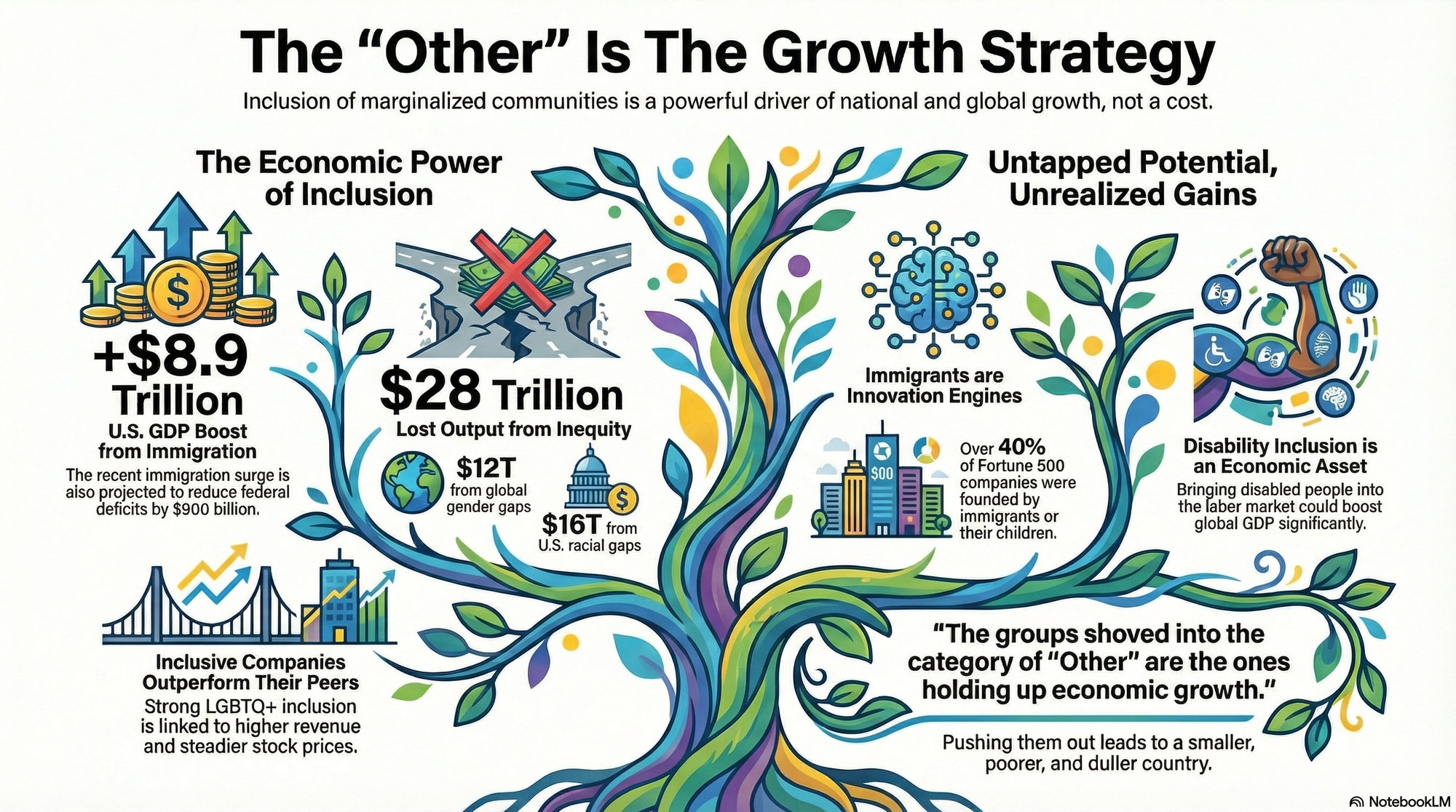
Here is what those speeches leave out: people like me are not nibbling away at a fixed, fragile pie. We are the ones baking it. We are the missing slices and the new recipes. When you look at the data on immigrants, on women, on people of color, on queer and disabled people, the story is the same. The groups shoved into the category of “Other” are the ones holding up economic growth. Push us out, and you do not get a safer, richer country. You get a smaller, poorer, duller one.
When politicians talk about immigrants, they rarely talk about zeros – the ones on paychecks, balance sheets, and GDP tables. They talk about “invasions” and “taking our jobs,” not about who is keeping an aging labor force alive. But if you strip away the fear, the numbers are clear. “Immigrants are one of the major reasons the U.S. economy is still growing at all.
The Congressional Budget Office estimates that the recent surge in immigration will boost U.S. GDP by roughly $8.9 trillion and reduce federal deficits by close to $900 billion over the next decade. Immigrants are also overrepresented in innovation and entrepreneurship; more than 40 percent of Fortune 500 companies were founded by immigrants or their children. The people we are told are “replacing” us are, in fact, helping invent the future and launching firms that employ millions of Americans.
So, when someone says we need to “get tough on immigration to protect the economy,” what they are really saying is: we are fine choosing a smaller economy, fewer jobs, and weaker innovation, as long as certain people are kept out.
The same math shows up when you look at the people who are already here but still treated as expendable: women and people of color.
When I walk into a room as a Black woman, some people see “representation.” Economists see massive unrealized growth. A major analysis from the McKinsey Global Institute found that advancing women’s equality could add about $12 trillion to global GDP by narrowing the gender gap in work and opportunity. Women are roughly half the world’s population but contribute a smaller share of measured GDP because our work is too often unpaid, undervalued, or blocked.
On race, a major report estimated that racial gaps in wages, education, housing, and business investment for Black Americans have already cost the U.S. economy about $16 trillion in lost output. Closing those gaps now could add trillions more in just a few years.
Put bluntly: racism and sexism do not just hurt people like me. They make the whole country poorer. Every time we push women and people of color to the margins, or dismantle the policies meant to bring us in, we are voting against our own growth. The dollars we lose are the dollars that disappear from the very companies and communities that refuse to support us.
Even as this evidence piles up, a new target keeps being painted on another group’s back: queer and trans people.
There is a myth that LGBTQ+ inclusion is a “distraction” from business, something companies cannot afford. The data says the opposite. An analysis using 15 years of Corporate Equality Index data found that companies with the strongest LGBTQ+ workplace inclusion enjoyed higher long-term revenue growth and steadier stock prices than those at the bottom. Cross-country research has found a similar pattern: more legal rights for LGBTQ+ people go hand in hand with higher GDP per person.
When queer people can work, invent, and live without terror, economies do better. LGBTQ+ equality does not sink the bottom line; it is a marker of a system that knows how to use all its talent.
The same is true for another group I belong to, one that often gets treated as an afterthought even inside diversity conversations: disabled and neurodivergent people.
As a disabled woman with a chronic illness, I live my life noticing friction. Every door that is too heavy, every website that is unreadable, every “simple” process that silently assumes a body or brain like yours instead of mine, sits like a stone in my day. That sensitivity is exhausting. It is also an economic asset.
International organizations call the cost of excluding disabled people from work “the price of exclusion,” and some analyses suggest that bringing disabled people fully into the labor market could boost global GDP by several percentage points. A government-backed review in the U.K. concluded that barriers facing disabled entrepreneurs – biased lending, inaccessible systems, the risk of losing benefits – may be costing the economy hundreds of billions in lost output, even as disabled-led businesses already generate a significant share of private-sector turnover.
When disabled people are allowed to solve our own problems, we often end up solving yours too. Different kinds of brains build different kinds of businesses. Yet when disabled and neurodivergent people ask for an accommodation or a more flexible way of working, we are treated as expendable instead of recognized as problem solvers.
Which is why the current wave of backlash feels so reckless. We finally have the data showing how much we all gain from inclusion, and this is the moment some leaders are choosing to slam the door.
We are watching leaders choose politics over profit and ideology over innovation. The math does not change just because you call someone “woke.”
When I say I live in the “Other” box, I am not only talking about identity. I am talking about a political project that is trying very hard to erase people like me from the story of who built this country and who keeps it running. That project targets immigrants, Black and brown workers, queer and trans people, disabled and neurodivergent people, and anyone else who refuses to shrink themselves for someone else’s comfort.
The numbers are not on that project’s side. The best evidence we have says that advancing women’s equality, closing racial gaps, welcoming immigrants, protecting LGBTQ+ rights, and bringing disabled people fully into the economy all raise growth rather than shrink it.
So, when you hear someone say, “We cannot afford all this diversity, all these accommodations, all these Others,” remember they are not protecting the pie. They are shrinking it.
If this resonated with you
I’m building The Economics of “Other” as an ongoing series—essays, data, and tools about what happens when the people we call “Other” stop holding up the world. I would love to have you along for the jouney.