The Architecture of Other
Othering is not an accident. It is produced. And yet here is the part the story leaves out. The very people cast as economic burdens are among the greatest contributors to growth, resilience, and innovation.
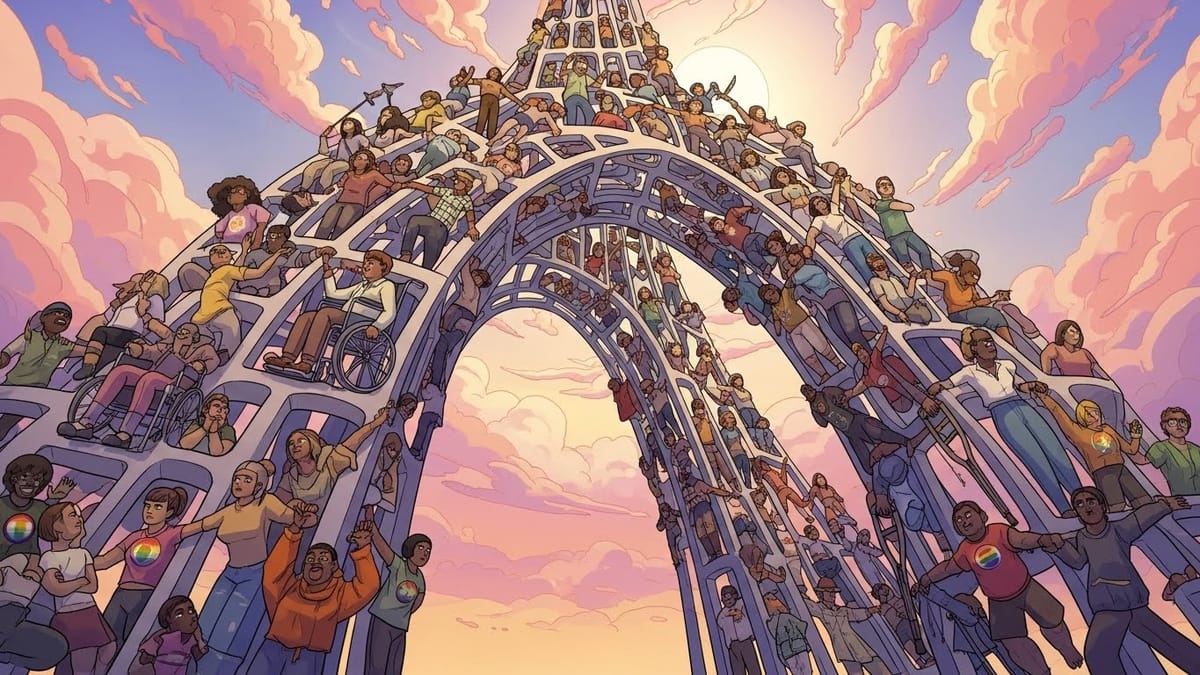
How Systems Decide Who Belongs
We are taught that the world is fair.
Not perfectly fair, perhaps, but fair enough.
That effort matters.
That talent rises.
That if you work hard, keep your head down, and follow the rules, the system will eventually recognize you.
This story is everywhere.
In classrooms.
In boardrooms.
In grant guidelines and admissions essays and performance reviews.
It is called meritocracy.
And it is one of the most powerful myths we have ever built.
Because it does not announce itself as a myth.
It presents itself as common sense.
I used to believe it too.
I believed that success was a matter of preparation meeting opportunity.
That if I learned the language, mastered the systems, earned the credentials, I would be welcomed inside.
And then I arrived inside.
And I felt the discomfort.
Not mine. Theirs.
The pause before a handshake.
The recalibration of tone.
The subtle surprise that I was not only present, but competent.
That I spoke the language fluently.
That I belonged in rooms never designed with me in mind.
It was there that I began to understand something meritocracy could not explain.
The system was not reacting to my effort.
It was reacting to my presence.
Meritocracy tells us that outcomes reflect individual effort.
But systems do not reward effort in the abstract.
They reward what they are designed to recognize.
They reward certain credentials and not others.
Certain communication styles.
Certain life paths.
Certain forms of labor that are visible, legible, and already validated.
They reward those who fit the shape.
And when someone does not fit, not because they lack ability, but because the system was not built with them in mind, we call that failure personal.
We call it lack of grit.
Lack of discipline.
Lack of professionalism.
We never call it design.
This is how Othering works.
Not primarily through hatred or bias, though those exist, but through architecture.
Through forms that ask the wrong questions.
Through categories that flatten lived experience.
Through policies that assume a single kind of worker, a single kind of family, a single kind of body, a single kind of mind.
Through systems that decide, quietly and efficiently, who will be seen and who will not.
The bridge that is too low for buses.
The job that assumes uninterrupted availability.
The funding process that mistakes polish for potential.
The “neutral” standard that mirrors those already in power.
Othering is not an accident.
It is produced.
And yet here is the part the story leaves out.
The very people cast as economic burdens are among the greatest contributors to growth, resilience, and innovation.
Immigrants, often framed as “taking jobs,” expand economies, adding trillions to GDP, founding companies, developing patents, creating demand where none existed before.
Women, whose labor is routinely undervalued or unpaid, represent one of the largest untapped sources of global economic growth. Entire economies rest on care work that is invisible precisely because it is assumed.
Black Americans, systematically excluded from wealth building and investment, represent trillions in lost economic output, not because of lack of talent, but because of barriers deliberately constructed and persistently maintained.
Disabled people, pushed to the margins of education, employment, and innovation ecosystems, generate ideas that reshape the world once accommodations are allowed to exist. Text messaging. Voice recognition. Curb cuts. Technologies born from exclusion, later adopted by everyone.
Queer communities, when granted safety and legal recognition, correlate with measurable gains in productivity, stability, and economic performance, not because identity itself creates value, but because fear suppresses it.
Caregivers.
Neurodivergent thinkers.
Those who live at the intersection of multiple margins.
The economy grows when the Other is allowed to participate.
This is not a moral argument.
It is economic fact.
So why does the myth persist?
Why, in the face of overwhelming evidence, do we continue to frame inclusion as charity rather than investment?
As risk rather than return?
Because stories protect systems.
And meritocracy is a story that justifies hierarchy by making it feel earned.
It tells those at the top that their position is natural.
That the system rewarded them because it was fair.
And it tells those at the margins that their exclusion is personal.
Meritocracy is not neutral.
It is a narrative that turns architecture into destiny.
There is another way to see this.
Not as a contest of individuals, but as a question of design.
Who gets funded?
Who gets admitted?
Whose work is legible?
Whose caregiving counts as labor?
Whose communication style is called “professional”?
Whose absence is treated as a loss, and whose absence goes unnoticed?
When we ask these questions, inequality stops looking inevitable.
It starts looking engineered.
This series, Economics of Other, is not an argument for pity.
It is an argument for accuracy.
It is an invitation to look at the systems we live inside, not as natural forces, but as constructed environments, and to ask what they are truly optimized for.
Because when we redesign systems to see what they have long ignored, something remarkable happens.
Merit stops being a myth.
And becomes a shared possibility.